


 03 9070 5784
 Help & Support
 Track My Order



Recently Viewed
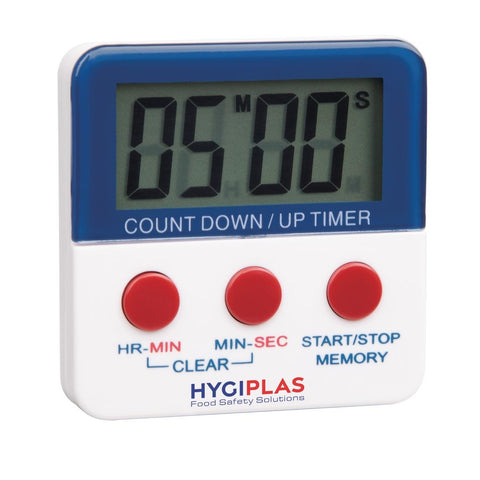

 Hygiplas Magnetic Countdown Timer - DP028
63(W) x 63(H) x 15(D)mm
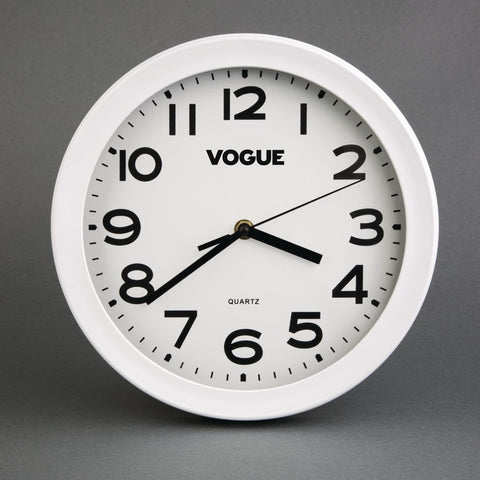

 Vogue Kitchen Clock - K978
240(W) x 50(H) x 240(D)mm
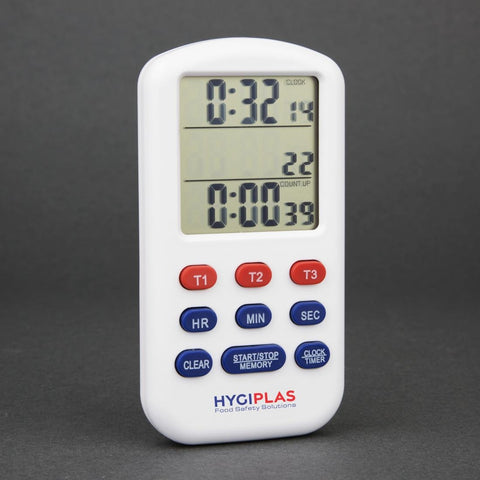
 Hygiplas Triple Timer - CF915
70(W) x 90(H) x 14(D)mm
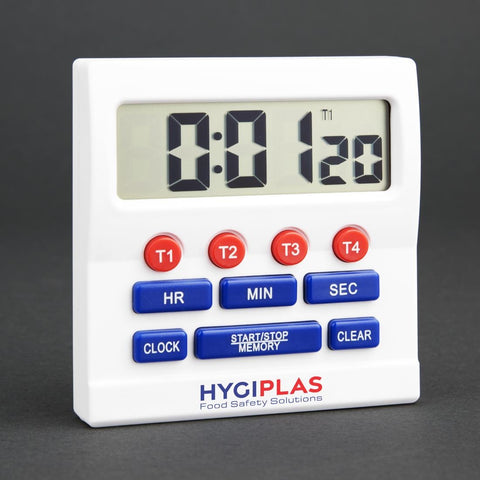
 Hygiplas Big Digit Timer - CF916
80(W) x 80(H) x 25(D)mm
Kitchen food timers stop a cook holding four cooking times in their head during a rush, which is the point at which something gets forgotten. A food timer is the smallest piece of equipment on a line and the one that keeps a section honest.
Single-channel timers are cheap and belong one per task. A multi-channel timer runs several counts at once from one unit, which suits a fryer or grill station where three things started a minute apart. The decision is how many things a station times simultaneously, not how fancy the unit is, so you can start with the stations that need covering now and add more as your business grows.
The practical features are a loud alarm that cuts through a kitchen, a magnetic or clip mount so it sits where it is seen, and a display readable from a step away. A timer in a drawer is not a timer. Site them near the deep fryer, combi oven and chargrill.
Pricing timers for several stations at once? Ask for the price guide and compare the single and multi-channel units side by side.
Single-channel, one per task, is the simplest and hardest to get wrong. Multi-channel suits a station juggling several cooking times from one position and saves bench space.
A fryer station is the usual case for multi-channel. A combi steam oven with its own programmed timers may not need one at all.
Louder than you think. A kitchen at full service has extraction, a dishwasher and voices in it, and a domestic timer chirp disappears into that completely.
Look for a volume setting and a visual flash as backup. Where the environment is very loud, a vibrating or flashing unit near the operator works better than a louder beep. Modular canopy extraction is usually the main noise source.
At eye level in the cook's line of sight, magnetically on a stainless surface or clipped to a rail. Not flat on the bench where a tray can cover it.
A kitchen bench overshelf or wall shelf is the usual mounting point above a station.
Count down for cooking, count up for holding and for tracking how long something has been out. Most units do both and the useful habit is deciding which the station uses by default.
Count-up is the one kitchens underuse. It is how you know how long a tray has been in the bain marie rather than guessing.
Splash resistance varies and is stated per model rather than being general. A timer beside a sink will get wet, so check it before siting it there.
None of them belong in a commercial dishwasher. Wipe the body and keep the back dry, because that is where the battery compartment is.
Long enough that it is never thought about until it stops, which is why a spare battery in the drawer is the whole answer. A dead timer gets replaced by guesswork.
Buy timers that take a common battery size rather than a specialty cell. Standardising on one size across the kitchen means one spare pack covers everything.
One per cooking station minimum, plus one on the prep bench for proving, marinating and chilling. Most kitchens are short rather than over-supplied.
They are inexpensive enough to over-order. The rest of the range is in commercial kitchen tools, and for temperature rather than time see food thermometers.

We have a special page just for stock that's warehoused in Perth.
Click Here to see all WA stockWhat our customers say about us on Google, and how Google scores our store for things like shipping and returns.
Store scores from Google